
💡 Introduction
Kenya has two major tax deduction systems that often confuse taxpayers:
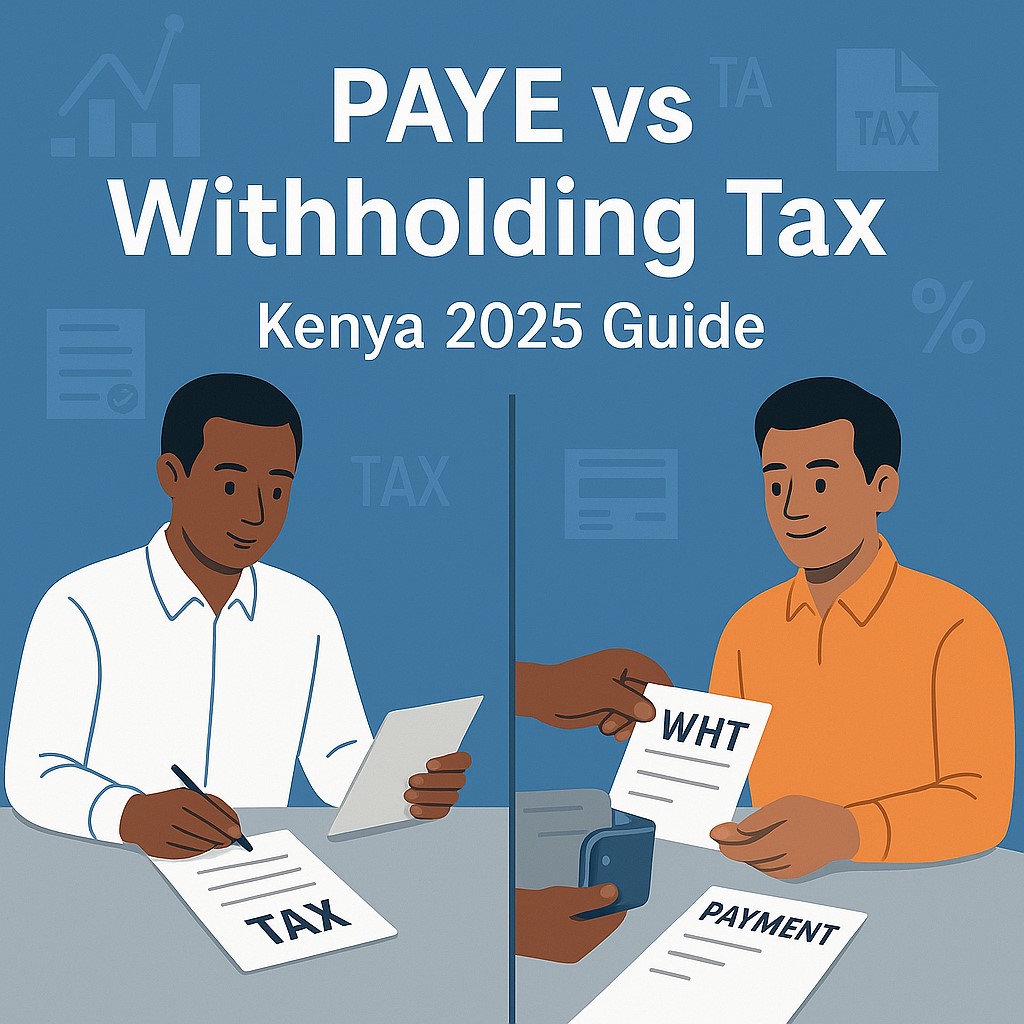
PAYE (Pay As You Earn) and Withholding Tax (WHT).
Although both involve deducting tax before paying someone, they apply to different types of income, follow different rules, and have different rates.
Understanding the difference can save you from penalties, audits, and misclassification — especially if you’re an employer, freelancer, landlord, consultant, or contractor.
This 2025 guide explains PAYE and WHT in the simplest, clearest way, using Kenyan examples.
1. What Is PAYE? (Pay As You Earn)
PAYE is a tax deducted from employees’ salary income.
✔️ Who does PAYE apply to?
Employees earning:
- Monthly salary
- Wages
- Bonuses
- Allowances
- Benefits-in-kind
- Overtime
- Commissions (if part of employment)
✔️ Who deducts PAYE?
The employer — including businesses, households, NGOs, and companies.
✔️ How often is PAYE filed?
Every month by the 9th.
✔️ Legal Basis
- Income Tax Act (Cap. 470)
- TPA Cap 469B (penalties & interest)
- Finance Act 2025 (updated PAYE bands)
2. What Is Withholding Tax (WHT)?
Withholding Tax is deducted from payments made to non-employees.
✔️ WHT applies to:
- Professional services
- Consultancy fees
- Management fees
- Rent (commercial)
- Commissions
- Interest
- Royalties
- Dividends
- Contractor payments
- Telecom & internet services
- Digital advertising (resident & non-resident rules differ)
✔️ Who deducts WHT?
The person making the payment (payer).
✔️ How often is WHT filed?
Monthly, by the 20th.
✔️ Legal Basis
- Income Tax Act (Cap. 470)
- TPA Cap 469B
- Finance Act 2025 (WHT rate adjustments)
3. Key Difference Between PAYE and Withholding Tax
Here is a simple comparison:
| Feature | PAYE | Withholding Tax |
|---|---|---|
| Applies to | Employee salaries | Non-employees |
| Who deducts? | Employer | Payer |
| Filing deadline | 9th monthly | 20th monthly |
| Rates | Graduated PAYE bands | Fixed WHT % |
| Employee/Contractor status | Employee | Consultant/vendor |
| Can it be final tax? | No | Sometimes yes |
| Refunds allowed? | Yes | Sometimes not (depending on final tax nature) |
| Requires eTIMS invoice? | No | Yes (for B2B services in 2025) |
| Must issue certificate? | P9 form | WHT certificate (KRA-issued) |
| Appears on iTax? | Employee ledger | WHT credits ledger |
4. When to Use PAYE vs When to Use WHT (Simple Rules)
Use PAYE when the person:
✔️ Works under your control
✔️ Works set hours
✔️ Uses your equipment
✔️ Is part of your organization
✔️ Is paid a salary or wage
This is an employee.
Use WHT when the person:
✔️ Works independently
✔️ Has multiple clients
✔️ Issues invoices
✔️ Is paid per project
✔️ Uses their own tools or expertise
This is a contractor or consultant.
5. Common Payments That Trigger WHT (2025)
✔️ 1. Rent (Commercial) – 10%
Tenants renting commercial premises must withhold 10%.
✔️ 2. Consultants – 5%
This includes:
- Accountants
- ICT professionals
- Auditors
- Lawyers
- Tax consultants
- Engineers
- HR consultants
✔️ 3. Professional Services – 5% to 20%
Depending on residency status.
✔️ 4. Internet & Telecom Services – 5%
Applicable to business consumers.
✔️ 5. Commission Payments – 5%
Agents, marketers, sales reps, and brokers.
✔️ 6. Management Fees – 5%
Company-to-company service fees.
6. Real-Life Examples (Kenyan Scenarios)
Example 1 — Employee (PAYE)
Sarah works full-time as a receptionist.
She earns KSh 35,000/month.
Her employer must:
✔️ Deduct PAYE
✔️ Remit by 9th
✔️ Submit P9 at year-end
Example 2 — Consultant (WHT)
Brian is an independent graphic designer.
He bills KSh 50,000 for a project.
The client must:
✔️ Deduct 5% = KSh 2,500
✔️ Remit to KRA
✔️ Issue WHT certificate
✔️ Pay Brian KSh 47,500
Example 3 — Commercial Tenant (WHT on Rent)
Alice rents a shop at KSh 100,000 per month.
She must:
✔️ Withhold 10% = 10,000
✔️ Pay landlord KSh 90,000
✔️ Remit KSh 10,000 to KRA
✔️ Issue WHT certificate
7. Penalties for Getting it Wrong
PAYE Penalties
- 25% penalty for failure to deduct
- 5% penalty for late payment
- 1% interest per month
- KSh 10,000 late filing penalty
WHT Penalties
- 10% for failure to deduct
- 5% for late remittance
- 1% interest monthly
- Tenant becomes liable for full amount if not withheld
8. Frequently Asked Questions (FAQ)
Q1: Can I apply both PAYE and WHT on the same payment?
No — classify the relationship correctly.
Q2: Is WHT final tax?
Sometimes (e.g., non-resident royalties).
For residents, it usually becomes a tax credit.
Q3: Do I need eTIMS for WHT payments?
Yes — invoices must be eTIMS-compliant.
Q4: What happens if I misclassify a contractor as an employee?
KRA will demand PAYE for previous months.
Conclusion
PAYE and Withholding Tax serve different purposes but are equally crucial for compliance.
Employers and SMEs must understand the distinction to avoid penalties — especially with KRA tightening enforcement via eTIMS and data matching in 2025.